
Until the 13th Century, the Grama murchana Jati system was in circulation. After that the Ragas were classified in Indian chiefly as follows.
- Rag Ragini Classification of Narada in Sangeet Makaranda.
- Shuddha Chayalaga and Sankeerna Classification
- Jati or Shadav, Oudav, Sampoorna Classification
The ancients classified all ragas in to Raga, Ragini, Raga Putra and Raga Putra Vadhu. This Classification is called the Raga Ragini Classification. There are 4 theories about it. According to the 4 theories,
- Shiva Matha
- Bharat Matha
- Kallinath Matha
- Hanuman Matha
Given below are the grouping of chief ragas of each Matha.
- Shiva Matha
-
- Six Chief Ragas
-
- Shree
- Basant
- Panchan
- Megh
- Bhairav
- Natanarayan
-
- Six Chief Ragas
Pandit Damodar describes this theory in his book named Sangeet Darpan as,
2. Bharat Matha
-
- Six Chief Ragas
-
- Bhairavi
- Malkauns
- heendol
- Deepak
- Shree
- Megh
-
- Six Chief Ragas
3. Kallinath Matha
-
- Six Chief ragas
-
- Shree
- Panchan
- Bhairavi
- Megh
- Natanarayan
- Vasant
-
- Six Chief ragas
4. Hanumat Matha
-
- Six Chief Ragas
-
- Bhairavi
- Malkauns
- Heendol
- Deepak
- Shree
- Megh
-
- Six Chief Ragas
Shuddha Chayalaga & Sankeerna raga classification was described in Raga Vibhodha written in the 17th Century by Pandit Somanath. According to this classification Shuddha Raga is rag which doesn’t require any other raga for it to display. Chayalaga Raga is a mix of two ragas. They are also called Salaga Ragas. Sankeerna ragas are are a mixture of several ragas.
According to the Jati Classification, ragas were basically divided in to 3 basic types. As OUDAV, SHADAV & SAMPURNA. These 3 basic types produce 9 subtypes as follows.
- Sampoorna Shadav
- Sampoorna Sampoorna
- Sampoorna Oudav
- Shadav Sampoorna
- Shadav Shadav
- Shadav Oudav
- Audav Sampoorna
- Audav Shadav
- Audav Audav
From each Thaat with these nine subtypes, 484 raagas can be made. Therefore, with 10 thaats, 4840 raagas can be made but as most of them are lacking sweetness, only about 200 raagas are in use.
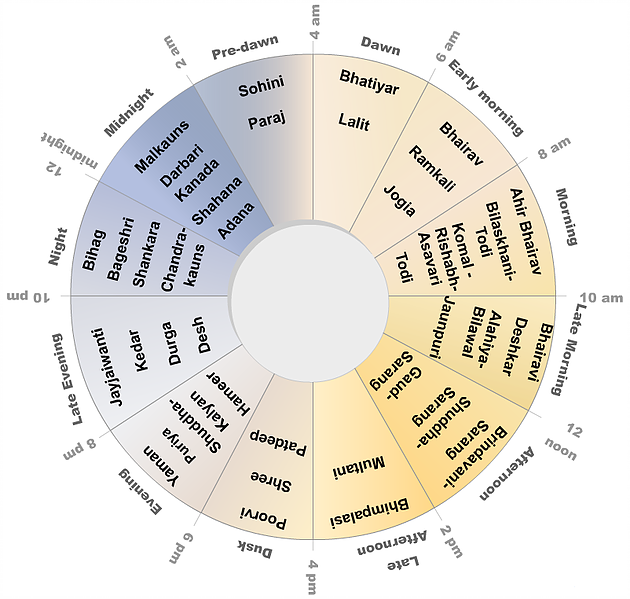
The raga-ragini scheme is a classification scheme used from the 14th century to the19th century. It usually consists of 6 ‘male ragas each with ‘wives’ (raginis) and a number of sons (putras) and even daughters-in-law. As it did not agree with various other schemes, and the ‘related’ ragas had very little or no similarity, the raga-ragini scheme is no longer very popular. However, they define a very important fact of Indian Classical Music and the Raga system is that the ragas do have personality and can be imagined to have relationships with each other.
 SWAR
SWAR 