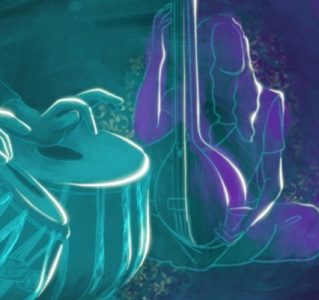
Dhrupad
Dhrupad is purely a legacy of the ancient temple music and prabandhas. It owns its origin to the temple music of Keertans and Bhajans sung in the morning and evening services in the temple at the time of worship. These Keertans were sung in Sanskrit language. Later in the 9th Century Keertans began to be sung in Hindi, Bengali and Vrij Bhasha.
Raja Man Sigh of Gwalior (1486-1516) is supposed to have started the Dhrupad style of singing. He was the great representative of this style. He composed several songs in this style and it is said to have brought the Dhrupad style of singing to its present state. During his time Gwalior had become the centre of Dhrupad singing. At that time Charju, Dhondhu Dalu and Bhagavan were the renowned Dhrupad singers and were called ‘Nayakas’. Almost all the singers of Akbar’s Court were also Dhrupad singers. During the reign of Akbar: Swami Haridas, Miyan Tansen, Sheikh Baijoo, Ramdas and Soordas were renowned Dhrupad singers whose Dhrupads are current even today.
Dhamar & hori
Dhamar and Hori are almost one and the same thing. When the Hori variety of song is sung in Dhamar taal, it is called Dhamar. In Dhamar & Hori, the subject matter is mostly the description of the color festival and the color throwing between Radha & Krishna. Dhamar has four parts: Stai, Antara, Sanchari & Abhog. it is sung with rhythmic evolution of the wordings of the song in Dugun, Tigun, Chagun and etc.
Hori too is sung like Dhamar. It also employees Dugun, Tigun, Chagun and is sung in Taal Dhamar. It also has four parts: Stai, Antara, Sanchaari & Abhog.
Tappa
Tappa is a musical lyric composition invented by one Gulam nabi known as Shouri Miyan. This famous musician was in Panjab, when he used to hear the songs of the camel drivers and composed songs in it calling them Tappas. The Tappa compositions themselves are full of long & charming Taanas, sometimes quite straight. It employees almost the same ragas & taalas as are used in Khayal singing. The wordings of the songs are in the language spoken in the Panjab or a mixture of Hindi & Panbaji. A special type of voice production and voice culture is needed for singing Tappa.
Thumri
The Thumri is purely an erotic song. There are more of acting, expression, voice modulation and feminine grace suitable to the words sense than the raaga intepretation. Thumri style of singing is said to have been introduced by the members of the family of Gulaam Nabi Shouri, the inventor of tappa style of singing. Thumris are sung in slow & medium tempo. Slow tempo Thumri is sung in taal Panjabi (a form of tritaal) & in in taal Deepchandi, while medium tempo Thumri is sung in Tritaal & Daadaraa.
Kajari
Kajari is a kind of a folk song which is sung during rainy season. It is mostly popular in Uttar-Pradesh. In Kajari, the theme is generally the description of rainy season and the sudden pain of seperation by the lover. It is mostly sung by the girls when enjoying or amusing a swing.
Saawan
Saawan is also a kind of folk song like Kajari. It also contains the description of rainy season and mostly sung during rainy season. It is also mostly sung by the girls.
Sargam
Sargam or Swara Malika is a kind of composition of the notes of a raga said to taala. Every raaga has a sargam and it is sung in different taalas.
Lakshan Geet
Lakshan Geet means the song that describes the characteristics of a raaga namely it’s notes, time of singing, vaadi, samvaadi, vivaadi notes and the song that is also composed in the swaras of the same raga.
 SWAR
SWAR 